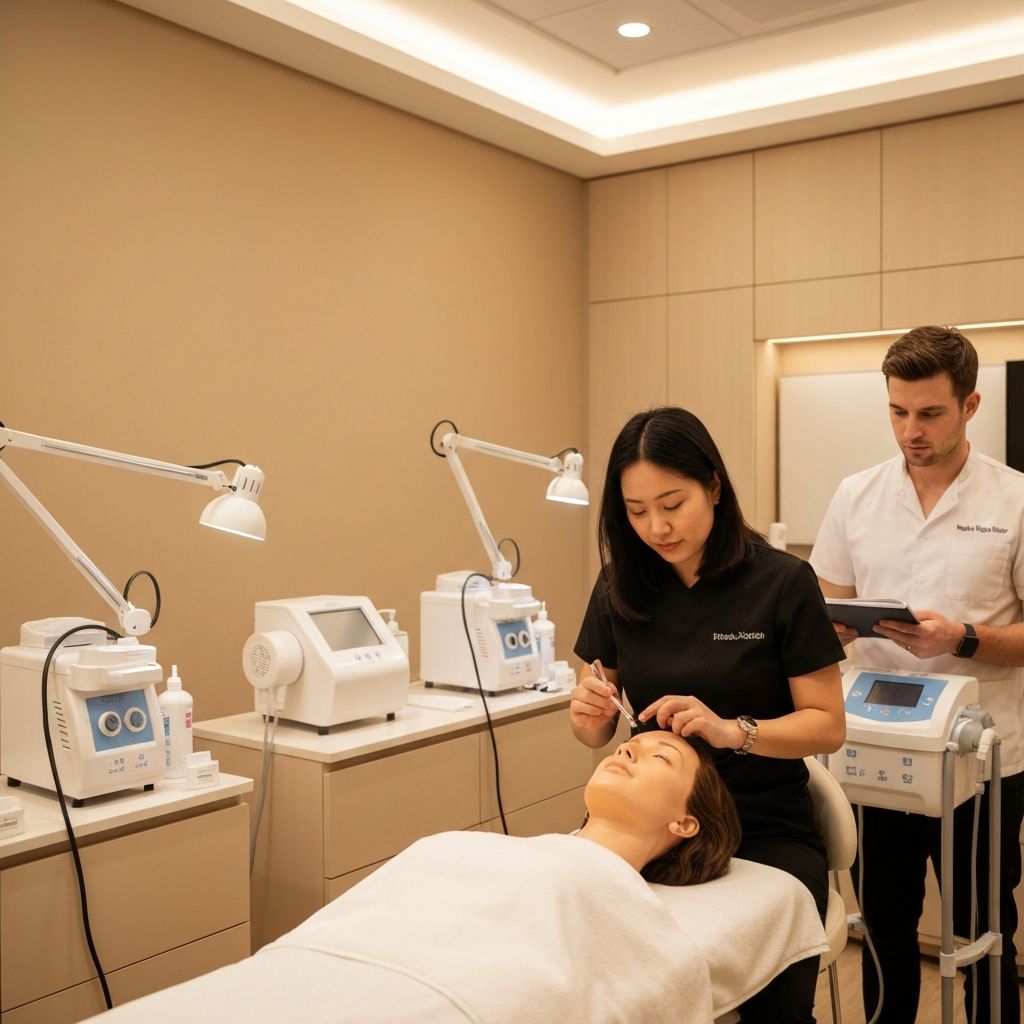
Why Class Size Matters in Injectable Training
The number of students in your injectable course directly affects how many reps and how much feedback you get. Here's why class size is a quality signal worth checking.

The short version: In hands-on training, fewer students means more supervised repetitions, faster feedback and more individualized correction — the things that actually build safe technique. When comparing injectable courses, treat class size and student-to-instructor ratio as core quality signals, not nice-to-haves.
Skill is built through supervised reps
Injecting safely is a motor skill layered on medical knowledge. You learn it by doing it, being corrected, and doing it again. In a large class, the available hands-on time is divided among more people, so each student gets fewer reps and less individual attention. In a small class, the same day yields more practice per person.
The practice-time math
Comparison — 16 students — Share of a 6-hour hands-on day: ~22 min of direct attention each; Practical effect: Watch more than you do. 8 students — Share of a 6-hour hands-on day: ~45 min each; Practical effect: Meaningful supervised reps. 3-4 students — Share of a 6-hour hands-on day: ~90+ min each; Practical effect: Repeated, corrected practice. 1-on-1 — Share of a 6-hour hands-on day: Full session; Practical effect: Maximum feedback density. These figures are illustrative, not promises, but the principle holds: smaller cohorts convert the same course length into more personal practice.
Feedback quality, not just quantity
Small classes let an instructor watch your hand position, catch errors early and tailor guidance to your background — a nurse and a career changer need different coaching. That individualized correction is hard to deliver at scale and is where confidence really comes from.
Confidence and safety go together
Confidence built on genuine supervised practice is safer than confidence built on watching. For higher-risk treatments, being observed and corrected while you work is exactly what prepares you to recognize and avoid problems later.
What to ask before enrolling
• What is the maximum class size and the student-to-instructor ratio?. • How many live models are there, and how many will I personally treat?. • Is instruction one-on-one during hands-on segments?. • Can I get individual feedback on my technique?.
Class size versus total course length
It's tempting to judge a course by how many days or weeks it runs, but length without small-group practice can be misleading. A longer course split among a large cohort may deliver less individual hands-on time than a shorter course taught one-on-one. When you compare programs, look at the combination of duration, class size and how many clients you'll personally treat — that trio, together, tells you how much real practice you'll get. Comparison — 5 days, 16 students — Course B: 3 days, one-on-one. More calendar time — Course B: More practice per hour. Watch-heavy — Course B: Do-heavy. Lower cost per day — Course B: Higher feedback density. Neither is automatically better — it depends on your budget and how you learn — but the comparison shows why 'longer' and 'more hands-on' aren't the same thing. If safe technique is the goal, weight practice density heavily in your decision. Ziba caps classes at eight students and emphasizes one-on-one, hands-on instruction — see Why Train With Us and the Botox & Filler course (for medical professionals). If you value practice density, prioritize programs that publish and protect small class sizes.
Ziba Aesthetics Training Institute
Ziba Aesthetics Training Institute is located at 7191 Yonge St, Unit 701, Markham, ON, serving the Greater Toronto Area. To learn more about the Botox & Filler program or discuss your goals, book a consultation or start your application with our admissions team.
Frequently Asked Questions
More Mezogel Booster Articles
Continue learning about Mezogel Booster treatments and training
- Mezogel Booster Treatment in Toronto: Complete Guide
8 min read
- Mezogel Booster Training and Certification in Ontario
7 min read
- Mezogel vs Profhilo: Comparing Skin Booster Treatments
9 min read
- 10 Benefits of Mezogel Booster for Skin Rejuvenation
10 min read
- How to Perform Mezogel Booster: Injection Techniques Guide
11 min read
- Mezogel Booster Side Effects and Safety: Complete Guide
10 min read
More Laser Training Articles
Continue learning about laser training, certification, and aesthetic careers
- Laser Technician Certification in Ontario: Requirements and Training
9 min read
- Advanced Laser Training for Experienced Technicians
7 min read
- Laser Training in Thornhill: Complete Certification Guide
12 min read
- Laser Hair Removal Training in Thornhill: Get Certified
11 min read
- Laser Skin Rejuvenation Training in Thornhill
11 min read
- Best Laser Training Center in Thornhill and Toronto
11 min read